Showing posts with label Sierra Club. Show all posts

Friday, September 26, 2025

Learn About the Arizona Legislature to Better Advocate with It

Sandy Bahr speaking at a committee meeting at AZ legislature

In addition to advocating for water conservation, climate action and environmental policies on the local  level, a big part of our work is weighing in on bills at the state legislature using the online Request to Speak system when the session starts up again January 12th. 

It only improves our advocacy to learn more about how the legislature works. In fact, I was inspired to start this group after attending the Sierra Club's Volunteer Lobby Workshop and Environmental Day at the Capitol. I would greatly encourage you to attend their upcoming Volunteer Lobby Workshop.. 

Volunteer Lobby Workshop! Learn About the Legislature

Date and Time:
Tue, Oct 7, 2025; 6:00 PM - 7:30 PM  (Arizona)

Organized By: Sierra Club Grand Canyon Chapter

Join the Sierra Club for this workshop to learn more about Arizona government, focusing on the Arizona Legislature, and how to lobby/advocate for change at the Capitol. They will cover the basics, including how a bill goes through the process, plus hear from people who have testified in committee and possibly from one of our legislators. They have allowed extra time for questions and answers.

Register to get the Zoom link:

https://act.sierraclub.org/events/details?formcampaignid=701Po000019073pIAA

Additional Directions: Send any questions you would like them to address ahead of time, but you will have time to ask during the workshop, too. sandy.bahr@sierraclub.org

Friday, August 1, 2025

2025 Environmental Report Card for AZ Legislature & Governor


Check out the 2025 Environmental Report Card!
See How Your Legislators Did This Session
A logo with red and blue and white spectrum of colors a dead tree and a dry riverbed and a group of people with a dog

The Sierra Club, joined by Chispa Arizona and Arizona Asian American, Native Hawaiian, and Pacific Islander (AANHPI) Advocates, released the 2025 Environmental Report Card for the Arizona Legislature and Governor.

“Not only did we not see any real progress on water issues, but we saw harmful utility bills signed into law, allowing old coal plants to continue operating after the utilities have bonded for their debt, continuing to pollute our air and water and fuel climate change,” said Sandy Bahr, director for Sierra Club’s Grand Canyon Chapter. “The Legislature and Governor also gave utilities liability relief for fires sparked by their infrastructure. The attacks on voting, especially early voting, continued, but those bills were vetoed and the referrals did not get to the ballot – at least not this time.”

See the full news release here and the report card in English here.


La Tarjeta de Evaluación del Medio Ambiente de 2025 está disponible en español

Some of the bad bills at the AZ legislature. 

Saturday, January 4, 2025

Time for Action! Speak to Your Legislators at Environmental Day at the Capitol

Join us for the annual lobby day, Environmental Day at the Capitol, to advocate for environmental issues in our state. This is an opportunity to meet with your legislators, hear from great speakers, and connect with others who are doing advocacy work both inside and outside the Arizona Legislature. No experience necessary. The Sierra Club will be providing online trainings and workshops leading up to this day. They also provide one-sheets on bills they support that protect the environment. Join a small group of fellow citizens from your district to speak to your legislators or just enjoy the presentations! 

Time to Act! Extreme Heat & Climate Justice
Environmental Day at the Arizona Capitol
February 12th, 2025
Arizona Capitol - Wesley Bolin Plaza
1700 W. Washington St.
Phoenix, AZ 85007

Please mark your calendar and RSVP. It is important to register so we know what legislative district you are in and also can plan for food and materials. Also, sign up for the free bus that is provided from Tucson.


Wednesday, August 21, 2024

Speak Up Against APS Gas Plant Expansion


Arizona Public Service (APS) is seeking a Certificate of Environmental Compatibility (CEC) to add approximately 397 megawatts (MW) of new gas to its existing 1,060-MW Redhawk gas-fired power plant in the western portion of Maricopa County. This proposed expansion will consist of 8 additional gas-fired turbines.


Why is this concerning?

The Redhawk power plant expansion project would increase air pollution in a part of Maricopa County that already has poor air quality. There is a residential neighborhood located less than two miles from the Redhawk plant, and Arlington Elementary School and its community sports fields are located less than 2.5 miles from the plant. Air pollution from the project will harm the health of nearby residents, including children. Exposure to air pollutants produced by gas-fired power plants causes increases in lung diseases, heart diseases, and premature deaths. Residents who live near power plants are generally exposed to more air pollution and therefore experience worse health impacts on average. Learn more and find talking points here.


Sign the petition here.

Monday, August 5, 2024

2024 Environmental Report Card for AZ Legislature & Governor

Session Characterized by Inaction on Key Priorities – Water, Climate, and Environmental Justice


Phoenix, AZ – Today, Sierra Club, joined by Chispa Arizona and Arizona Asian American, Native Hawaiian, and Pacific Islander (AANHPI) for Equity, released the 2024 Environmental Report Card for the Arizona Legislature and Governor.


“The 2024 legislative session was disappointing as legislators again missed opportunities to act on climate, environmental justice, and water, and unfortunately passed water legislation that does more harm than good, failing to address groundwater issues for rural Arizona or protect any rivers or streams,” said Sandy Bahr, director for Sierra Club’s Grand Canyon Chapter. “As if that were not bad enough, legislators loaded up the ballot with referrals, including one to make it difficult to advance rules to protect our air and water, one to target immigrants, and one to hinder citizen initiatives.”


While nearly everyone seemed to agree that Arizona needed to take action on water, especially as wells in rural Arizona continued to be pumped dry by industrial agriculture and an assured water supply was no longer available in parts of the Active Management Areas. It turns out, however, that developers, big agriculture, land and water speculators, and private water companies were all interested in continuing business as usual with unsustainable sprawl development and pushing through bills that changed the rules to accommodate that. The rural water issues were left unaddressed as there was no agreement on doing something meaningful.


“How will our younger and future generations see us? To know that we continuously chose profit over one another, over our home, our water, and over the healthy future of our children and loved ones,” said Nile Bunger, climate justice director with Arizona AANHPI for Equity. “The one place they rely on to keep them safe. What will the children say? How will we respond? Will we feel confident in our responses? If we can’t fight to save our planet outside of earth day, how can we expect our children to? One of the biggest acts of love we can give to one another is protecting our water rights and environment for all; although, time and time ago we ignore the concerns that are negatively affecting our BIPOC, rural, and marginalized communities. Our youth and younger generations are learning how to be humans based on how we act as a human. The policies we create and support, the elected officials we vote into office, and if we hold them accountable or not when our voices and needs are being harmed over profit. A healthy environment and access to clean water should not be a privilege, yet it is. It is vital that we do not exclude the voices of the community and the future of Arizona’s water rights. Our rural areas and communities deserve better. And may we remember that we are all part of nature, so we must act as such.”


“The Arizona legislature holds great power and ability to make laws that impact us in our daily lives,” said Alondra Morales, climate justice program coordinator forAZ AANHPI for Equity. “This report card serves as a clear summary of which legislators have the community in mind and which legislators have other priorities. I hope this is helpful guidance to the people of Arizona to get to know their legislators!”


“It’s very clear that lawmakers who hold the majority at the legislature do not look out for the interests of the people of Arizona. Every step of the way during this legislative session we saw them ignore the will of the people and act in ways that benefit private interests,” said Vania Guevara, political and advocacy director for Chispa Arizona. “We will continue to work diligently to connect our people to their own power by showing up in this space because we belong there. We will keep partnering with legislators that are environmental justice champions to push this body to protect the air we breathe, our access to public lands, and our right to an easy and accessible democracy.”


One senator and 14 representatives earned an “A+” on the 2024 Environmental Report Card – they voted pro-environment and did not miss any votes. Unfortunately, all of the Republican caucus earned an “F” this year as they pushed a plethora of bad water legislation at a time when we desperately need strong protections for groundwater, as well as for our rivers and streams. They also voted for a large number of referrals that, if passed, would seriously harm efforts to advance clean energy, protect our air and water, and our democracy.


The 2024 Environmental Report Card  is available on the website in English here and Spanish here.


The Sierra Club is one of the largest and most influential grassroots environmental organizations in the U.S., with more than 3.5 million members and supporters. In addition to protecting every person’s right to get outdoors and access the healing power of nature, the Sierra Club works to promote clean energy, safeguard the health of our communities, protect wildlife, and preserve our remaining wild places through grassroots activism, public education, lobbying, and legal action. The Grand Canyon Chapter of the Sierra Club, representing 16,000 members, has a long history of advocacy at the Arizona Legislature.


Chispa Arizona builds the capacity of Latinx families to influence policy makers and pressure polluters to protect communities’ rights to clean air and water, healthy neighborhoods and a safe climate for generations to come.


Arizona Asian American Native Hawaiian and Pacific Islander (AANHPI) for Equity is a state-wide organization striving for equity and justice by building power through community directed organizing, increasing civic engagement, and empowering young leaders.

Monday, June 24, 2024

Arizona Legislature session ends but not without some damage

bye bye

Here is an update on the end of this legislative session from Sandy Bahr from the Sierra Club. 

Phew! The Arizona Legislature finally adjourned sine die last Saturday and we can all breathe a little bit easier. They did more than their fair share of harm before heading out, however, including a godawful budget that does little to prepare Arizona for the challenges we face, a plethora of bad water bills, and a couple more bad referrals.

I will provide a quick overview here, but look for our Environmental Report Card on the Legislature for a fuller picture.

In the last two days of the session, legislators sent nine water bills to the Governor's desk, she signed four of them and vetoed five of them. She should have vetoed them all as none of them make our water future more sustainable and none of them take the comprehensive approach she said she wanted relative to water. Read more about the bills here and here. There is some talk of a special session to address the 80 percent of the state that has no groundwater protections. Frankly, having seen what transpired during the session, I am not optimistic about a special session.

Unfortunately, the Governor also signed a bill to exempt more actions from the Arizona Power Plant and Line Siting Committee process that requires a certificate of environmental Compatibility. HB2003 replacement lines; structures; commission hearings (Griffin) allows a utility that previously received a Certificate of Environmental Compatibility (CEC) to replace a cable or wire on a transmission line or an existing structure with a new structure without getting a new CEC, but it must be in compliance with the existing CEC. Unfortunately, it includes a big loophole for any lines that were sited prior to 1971. Utilities failed to provide any kind of information on what lines or how many would be affected. The bill could have been easily fixed and Senator Sundareshan offered an amendment to do so, but the proponents refused to remove the pre 1971 loophole. Those lines had no review by the Committee, no CEC, and no terms and conditions with which to comply. Modifications could have significant impacts to natural and cultural resources. This passed and was signed by the Governor.

In the good news category, the Governor vetoed HB2376 federal government; land acquisition; consent (Diaz: Hendrix). It mandated approval by the state legislature for any land sale to the U.S. Government. This was a measure to block acquisitions to protect lands around the headwaters of rivers and springs, inholdings, and to otherwise protect blocks of public lands or areas with special habitat or cultural resources.

HB2377 federal lands; state management costs (Diaz: Hendrix, McGarr) would have required the Auditor General and the Joint Legislative Budget Committee to complete a cost and revenue study of the annual costs to manage all federal public land in Arizona and all current revenue generated by federal lands. This measure did not include the indirect revenues and benefits for these public lands and would provide a skewed perspective on these important lands. This failed to go to a final read in the House, so died.

Also in the good news category was that none of the bad energy and transportation referrals reached the ballot. HCR2040, HCR2049, and HCR2050 all failed to get a floor vote in the Senate.

HCR2040 public monies; prohibited expenditures (Smith: Biasiucci, Carbone, et al.) would have placed a measure on the 2024 ballot to prohibit the state or any political subdivision, including universities, to spend any public dollars to reduce global temperatures, have a climate action plan, participate in anything related to reducing meat consumption, do anything to address impacts of racism, etc. It never came to the Senate Floor.

HCR2049 had a strike-everything amendment that would have referred to the ballot a constitutional amendment to prohibit any fees based on vehicle miles traveled. As we reduce reliance on gasoline and gasoline-powered vehicles, gas tax revenues will continue to decrease and other ways to fund road maintenance are needed such as looking at vehicle miles traveled. This never came to the Senate Floor.

HCR2050 energy source; restriction; prohibition (Griffin: Biasiucci, Bliss, et al) would have put on the 2024 ballot a proposed constitutional amendment to prohibit a city, town, county or any other political subdivision of the state from restricting the manufacture, use or sale of a device based on the energy source that is either used to power the device or consumed by the device. This would have made it harder to protect our air, our water, our health, and our communities. It never came to the Senate Floor.

The legislature also failed to bring HCR2056 elections; foreign contributions; donations; certification (Montenegro: Biasiucci, Bliss, et al.), across the finish line. It would have referred a ballot measure to restrict voting accessibility, create more administrative burdens to the detriment of voters, and leave election officials with little to no support. It failed to reach the Senate Floor for a Third Read.

The bad news again is they did refer several bad measures that may appear on the ballot, including the following.

SCR1041 ballot measures; challenges (Mesnard) refers a measure that allows challenges to proposed ballot measures by any person and earlier in the process. This would be hinder ballot measures as they could be challenged while people are still collecting signatures.

SCR1044 judicial retention elections (Gowan: Shamp) refers to the 2024 ballot a measure that eliminates terms of office for judges and allows them to continue to serve during “good behavior" and reduces the frequency of judicial retention elections.

HCR2060 Now: border; benefits; fentanyl; illegal entry (Toma) will be on the ballot for this fall, unless the constitutional challenge to it is successful. LUCHA is suing because the measure includes more than one subject and that is prohibited by the Arizona Constitution. This referral will make it easier for law enforcement to engage in racial profiling and to investigate and detain suspected undocumented individuals. It is very likely unconstitutional, would cost the state a lot, and, of course, is inhumane, seeking to criminalize people for seeking opportunities and reuniting with their families.

The budget, again, was not great on many levels, but certainly from an environmental perspective. Even during the best of times, environmental programs are underfunded. This budget included nothing for the State Parks Heritage Fund, no dollars for the Arizona Trail, no funding for Trees for Kids, and a lot of environmental fund diversions. It did include some funding for water quality programs at the Arizona Department of Environmental Quality and at least there was no funding for the Water Augmentation Fund -- that was intended for the big desalination project.

Thank you, thank you, thank you for all of your support and actions throughout this session. You make a difference! You can see more bills we tracked here and look for the report card on the Legislature in the coming weeks.

See below for an interim committee at the Legislature.

Joint Legislative Ad Hoc Study Committee on Water Security Friday, June 28 at 1:00 PM

Members of the public may access a livestream of the meeting here:


https://www.azleg.gov/videoplayer/?clientID=6361162879&eventID=2024061051


AGENDA

1.

Overview of Amended SB 1221 – Senate Research Staff


2.

Comparison of AMAs, INAs, and BMAs – Dan Jones, Salmon Lewis & Weldon PLC


3.

Agricultural Perspective on Groundwater Management Act Origins – Ron Rayner


4.

Overview of Changes and Concessions Made from Introduced SB 1221 to Current SB 1221 – Stefanie Smallhouse, Arizona Farm Bureau Federation


5.

Significance and Value of Closing a Basin on Rural Economies, Groundwater Conservation, and Aquifer Protection –

a.   Arizona Department of Water Resources

b.   University of Arizona Department of Agricultural & Resource Economics

c.   Bas Aja, Arizona Cattle Feeder' Association


6.

Agricultural Industry Testimony on Good Faith Negotiations –

a.   Phil Bashaw, Arizona Farm Bureau Federation

b.   Nicholas Kenney, Maricopa County Farm Bureau

c.   Zach Fort, United Dairymen of Arizona

d.   Rob VanHofwegen Jr., Paloma Irrigation & Drainage District

e.   Robert Meddler, Western Growers Association

f. Jadee Rohner, Arizona Cotton Growers Association

g.   Patrick Bray, Arizona Farm & Ranch Group


Fate of Arizona's recent environmental legislation: 25 bills introduced, one new law

Thursday, June 6, 2024

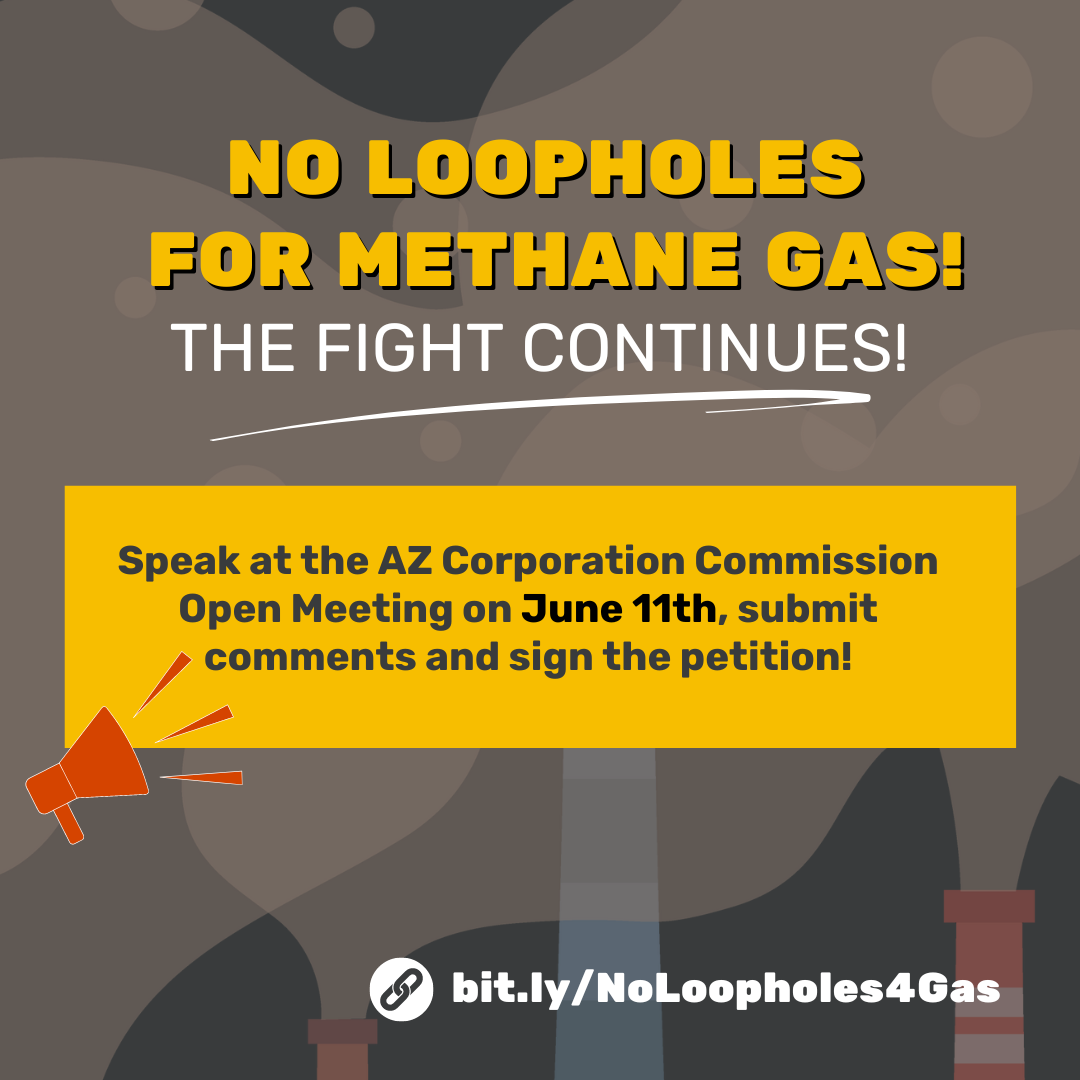
Urge the ACC to stop big utilities from siting gas plants without environmental review

Coolidge Plant sm.jpg

UNS Electric, a sister company to Tucson Electric Power, is trying to create a loophole to avoid environmental reviews and scrutiny regarding the impact of siting a large gas power plant. Currently, these larger plants must get a certificate of environmental compatibility (CEC) from the Arizona Power Plant and Line Siting Committee where they evaluate the impacts of the proposed plant versus the need.

If UNSE is successful with creating this loophole, other utilities – APS, SRP, and TEP – will follow and we could end up seeing a rush of big gas plant sitings that have no environmental review.

In April, the Arizona Power Plant and Line Siting Committee voted 9-2 to deny UNSE's request to eliminate the CEC requirement. Now, UNSE has appealed that decision to the Arizona Corporation Commission (ACC).

Sign the petition to the ACC. Tell them to uphold the AZ Power Plant and Line Siting Committee decision and to say no to this big loophole!  If you would like to submit a written comment - it is due by Friday, June 7th. 


https://act.sierraclub.org/actions/Arizona?actionId=AR0445282


HERE ARE 4 THINGS YOU CAN DO


1.Speak Telephonically or In Person at the June 11th ACC Open Meeting
2.Submit Individual Written Comments to the Docket by June 7th.
3.Sign a petition that we will submit to the AZ Corporation Commission
4. Share call to action on social media. 


More details on the Sierra Club's Action kit: 


https://docs.google.com/document/d/10DUC91-1yfq1yi3E1W05iyFHtfdt98OshguoOu89LfM/edit?usp=sharing

Monday, January 1, 2024

Learn More About Rainwater Harvesting - Zoom presentation


Learn More About Rainwater Harvesting - Zoom presentation hosted by the Sierra Club Grand Canyon chapter

https://www.youtube.com/watch?v=VHb6famFFKg Dan Stormont, a certified water harvesting practitioner and member of the Sustainable Tucson Water Committee, gives a presentation about the current water situation in Arizona, likely future trends, and the resources available in your home, like rainwater and greywater harvesting, to create a lush landscape without relying on tap water.

Dan Stormont is a computer engineer by training who has a passion for the intersection of technology and sustainability. Dan has been active in the Tucson community as an organizer for several tech meetups, but also as a docent with Watershed Management Group, a certified water harvesting practitioner, and as a member of the Sustainable Tucson Water Committee. He also teaches rainwater and greywater harvesting rebate classes for Tucson Water.
Other Sierra Club Zoom lectures on water and advocating for the environment here:

Sunday, June 25, 2023

Tell EPA: Adopt strong carbon rule for coal & gas power plants


Included is the Sierra Club's update on happenings at the State Capital and the Arizona Corporation Commission. Please, find the call to action (below) urging the EPA to adopt the strongest possible carbon rule for coal and gas power plants.

The Arizona Legislature was not in session this week and won't be back until July 31st, but there was a lot of activity nearby, some of it good -- vetoes by the Governor -- and some of it bad -- a reversal by the Arizona Corporation Commission on two issues.

Starting with the good news, the Governor vetoed several harmful bills, including HB2618, a bill that would have impeded solar development, and SB1246, a measure that would have required referring a harmful transportation proposal in Maricopa County, limiting transit.

Please send a quick thank you to the Governor for these vetoes. You can send her a note here.

Meanwhile, down the road at the Arizona Corporation Commission, the Commission approved a harmful settlement with Arizona Public Service (APS) and reversed a decision to deny a certificate of environmental compatibility to massive power plant expansion at Coolidge. Read more about those decisions here.


In other news, the Environmental Protection Agency has proposed a  carbon rule for coal and gas power plants. This is an important opportunity to move us closer to our carbon emissions reduction goals and get us closer to being on track relative to stabilizing the climate. Please use the link below to take action on the carbon rule today. Tell EPA to adopt the strongest possible rule.

https://actionnetwork.org/petitions/submit-your-comment-on-the-epas-proposed-cut-climate-pollution-plan/?source=az-sc

Wednesday, May 31, 2023

Speak out @ EPA Public Hearing - Greenhouse Gas Standards and Guidelines for Fossil Fuel-Fired Power Plants


This week, the Sierra Club shared two very important calls to actions requesting public comments on: the APS rate case at the ACC that I posted yesterday and the EPA Public Hearing - Greenhouse Gas (GHG) Standards and Guidelines for Fossil Fuel-Fired Power Plants (see below.)
We understand that these calls to action require more time and thought than a simple petition or survey. So the Sierra Club included everything you need in an action kit for the APS Rate Case.

And at 5:30 p.m. tonight (May 31st) there is an online information session on What the EPA’s Cut Climate Pollution Plan Means for AZ & How to Testify. <use this to register.

The U.S. Environmental Protection Agency (EPA) is holding a virtual public hearing on June 13, 14 and 15, 2023, to provide the public the opportunity to present comments and information regarding the Agency’s proposed Greenhouse Gas (GHG) Standards and Guidelines for Fossil Fuel-Fired Power Plants. Note: the first two days have filled up so they will continue the public hearing on June 15, 2023. EPA will announce further details and updates at: https://www.epa.gov/stationary-sources-air-pollution/greenhouse-gas-standards-and-guidelines-fossil-fuel-fired-power

In this action, EPA is proposing Clean Air Act emission limits and guidelines for carbon dioxide from fossil fuel-fired power plants based on cost-effective and available control technologies. The proposals would set limits for new gas-fired combustion turbines, existing coal, oil and gas-fired steam generating units, and certain existing gas-fired combustion turbines.

Remaining Date and Time


Thursday, June 15, 8 AM - 1 PM Arizona time

Location

Online Virtual Platform

If you have any questions about the hearing or need help registering, please email: EGU-GHG-Public-Hearing@rti.org

Registration

The last day to pre-register is June 6, 2023. Please submit a separate registration form for each person attending or speaking. You will receive an email from EGU-GHG-Public-Hearing@rti.org with your unique connection information. 

Note: EPA will use your registration information solely for this event. If you register to speak, we will post your name and affiliation as part of the hearing agenda. No other information you provide, such as contact or personal information, will be included on the hearing agenda or shared with any third party.

EPA will take written comments on the proposal until July 24, 2023.

EPA considers all comments equally, whether submitted in writing to the docket or given orally at a public hearing. Each speaker will have 4 minutes to speak. If time allows, the EPA will provide an opportunity for public hearing attendees, who did not preregister, to provide oral testimony.

EPA will announce further details and updates at: https://www.epa.gov/stationary-sources-air-pollution/greenhouse-gas-standards-and-guidelines-fossil-fuel-fired-power

This meeting will be held through a virtual platform. A link to the meeting and any additional instructions will be sent to your email address after registration closes. There is also an option to call into the meeting; that information will be provided after registration closes.

Additional Information/Questions

To read the proposal and fact sheets, please visit https://www.epa.gov/stationary-sources-air-pollution/greenhouse-gas-standards-and-guidelines-fossil-fuel-fired-power

If you have any questions about the hearing or need help registering, please email our hearing coordinators at: EGU-GHG-Public-Hearing@rti.org, or contact the SPPD Public Hearing Team by email: SPPDpublichearing@epa.gov; or by telephone: 888-372-8699.

Tuesday, May 30, 2023

Ask ACC for more clean energy and support for a just and equitable transition in APS rate case

Four Corners Generating Station

The Sierra Club has put together an action kit (below) with several actions (along with talking points) you can take on this important issue. If you don't feel comfortable talking, you can share the action with others. 

ACTIONS YOU CAN TAKE: 
  1. Speak at one of the public comment sessions either telephonically or in person or both.
  2. Submit written comments to the docket.
  3. Share on social media and/or share the information with a friend.
  4. Write a letter to the editor pointing out the concerns with this rate case.
Arizona Public Service (APS) filed for a rate increase with the Arizona Corporation Commission (ACC) that would result in an annual net rate increase of $460 million, which would result in a net 13.6% bill increase for ratepayers.

In this rate case, APS asks ratepayers to pay for the continued operation of its polluting, outdated coal-fired power plants, even though those plants are no longer economical to operate and are more costly than clean energy alternatives. Since the last rate case, APS has spent hundreds of millions of dollars in capital expenses and operations and maintenance costs at its fossil-fueled power plants, including the coal-fired Four Corners Generating Station, where APS has just announced it will postpone a switch to reduced seasonal operations, and the coal-fired Cholla Power Plant. APS proposes to spend hundreds of millions more to keep Four Corners operating until 2031. APS can save ratepayers money and reduce pollution by retiring the Four Corners Power Plant prior to 2031 and replacing it with lower-cost renewable energy. Ratepayers should not have to pay for APS’s irresponsible spending to keep Four Corners running until 2031.

APS has also doubled down on fossil gas, spending over $100 million on its Sundance and Redhawk gas plants. On top of its existing coal and gas, APS is also proposing to add even more new gas through an upcoming “Request for Proposals,” even though renewables and storage are cheaper and more reliable.

Unlike Tucson Electric Power, APS is requesting approval of coal community transition (CCT) funding for communities impacted by coal-fired power plant closures. APS proposes $106.5 million in funding over nine years to support coal community transition, including for the Navajo Nation, Hopi Tribe, and the areas around Joseph City where the Cholla Power Plant is located. This funding is urgently needed to help these communities transition from coal to clean energy, although it is not enough to meet the need.

ACTION KIT:

Our key asks of APS and the ACC are:

  • APS should retire the Four Corners Power Plant prior to 2031 and replace it with lower-cost renewable energy, which would save ratepayers money and reduce pollution.

  • Ratepayers should not have to pay for APS’s irresponsible, unjustified spending to keep the costly, dirty Four Corners Power Plant running until 2031.

  • APS should switch Four Corners to seasonal operations in 2023 as originally planned.

  • APS should close Cholla Power Plant by no later than 2025 as scheduled.

  • The ACC should approve funding for Coal Community Transition for communities impacted by coal plant retirements. APS’s proposed funding of $106.5 million CCT funding proposal is an important first step and should be approved by the Commission.

  • APS should increase investments in energy efficiency and demand-side management (DSM) programs that save ratepayers money.


  1. SPEAK AT ONE OF THE PUBLIC COMMENT SESSIONS

Date

Time

June 1, 2023

1:00 p.m. to 4:00 p.m., or until the last caller is finished speaking, whichever comes first

June 7, 2023

6:00 p.m. to 8:30 p.m., or until the last caller is finished speaking, whichever comes first

June 20, 2023

10:00 a.m. to 1:00 p.m., or until the last caller is finished speaking, whichever comes first  

June 20, 2023

6:00 p.m. to 8:30 p.m., or until the last caller is finished speaking, whichever comes first

July 31, 2023

10:00 a.m. to 1:00 p.m., or until the last caller is finished speaking, whichever comes first


We would especially like to have a strong turnout for the June 7th meeting.


To attend in person, go to 1200 West Washington Street, Phoenix, Arizona 85007 and enter from the back or north side of the building. You will need to go through security to enter.

To speak in person, either complete a "Request to Speak" form on one of the kiosks in the lobby at the ACC or fill out a paper slip or use your computer or mobile device ahead of time and request to speak via the ACC Portal here: https://efiling.azcc.gov/cases 


To provide telephonic comments, phone 1-877-309-3457, then enter the passcode 801972877#.

The comments are usually limited to three minutes in length.

  1.  SUBMIT WRITTEN COMMENTS TO THE DOCKET

  1. Be sure to include the docket number at the top of your comments – Docket Number E-01345A-22-0144

  2. Use the talking points listed below for your comments, plus include any specific reasons you are concerned about this rate case. Tell your story!

  3. You can mail your comments to:  Arizona Corporation Commission, Consumer Services Section, 1200 West Washington, Phoenix, AZ 85007

  4. You can submit your comments electronically or ask us to drop them off for you.

To submit a public comment, go to https://efiling.azcc.gov/cases, Click on “Make A Public Comment in a Docket.” Complete your information and click “Submit.”

Talking Points


Personal Financial Burden


  1. The proposed 13.6% rate increase is too much following a time in which we have lost income as Arizona  residents survived the hardship of decreased wages and lost jobs during a global pandemic.

  2. Bill increases have come too often –  this is the second proposed rate increase in just three years..


Continued Spending on Dirty, Expensive Coal Plants


  1. APS cannot keep charging ratepayers for its dirty, expensive coal. APS is continuing to spend money on the dirty, expensive, and outdated coal-fired Four Corners and Cholla power plants, and is seeking to recover those expenses from ratepayers. The costs to keep operating APS’s coal plants exceeds the costs of alternatives like renewable energy. APS fails to justify those high costs, and relies on flawed and outdated analysis. Ratepayers should not have to pay for APS’s imprudent spending on fossil fuels.


  1. APS can save ratepayers money by speeding up the retirement of Four Corners Power Plant and switching to cleaner and cheaper renewable power sources. Four Corners Power Plant is slated to retire in 2031, but an earlier retirement date can save ratepayers tens of millions and perhaps hundreds of millions of dollars, while keeping that additional carbon and other air pollutants out of the air. 


  1. Renewables are cheaper and cleaner than coal. Clean energy resources like solar, wind, and battery storage are cheaper, cleaner, and more reliable than APS’s aging coal plants.


  1. Across the nation, coal use is swiftly declining. By propping up polluting, toxic coal-fired power plants, APS isn’t preparing for a future that prioritizes a transition to clean energy – holding Arizona back. 


Environmental Justice and Coal Community Transition


  1. APS is asking ratepayers to pay for dirty, expensive fossil fuel infrastructure that pollutes communities and harms public health. 


  1. APS should not be burning coal or gas, or proposing new gas plants when we have a climate crisis.


  1. APS is proposing to provide $106.5 million in funding for coal community transition, which is an important first step, but not enough to meet the needs of impacted communities. The ACC should support APS’s proposed funding and the requests of the Hopi Tribe and Navajo Nation, as well as the grassroots Indigenous groups who have requested a just and equitable transition for these coal-impacted communities.

  2. The burning of fossil fuels continues to occur at the cost of the environment and health of communities of color. Coal plants emit thousands of tons of harmful pollutants that pose serious public health concerns, like increased asthma attacks, bronchitis, and heart attacks. Black, Indigenous, and people of color communities bear a disproportionate air pollution burden, and cleaner alternatives must be prioritized.2


Energy Efficiency


  1. APS should be increasing investments in energy efficiency, which can reduce customer bills.


  1. APS has not invested enough in cost-effective programs to increase energy efficiency and reduce peak energy demand.

  2. Lack of energy efficiency in homes forces higher energy costs, disproportionately affecting Black, Indigenous and People of Color (BIPOC) and those of low and fixed incomes. These higher costs can lead to households going without needed electricity, which is uncomfortable and unsafe. 

  3. Investing in energy efficiency helps keep electric bills lower and as noted above can lower energy burden on those with low incomes.

  4. Energy efficiency programs are the lowest-cost energy option available.

  5. We need to invest in what works. When we invest in efficiency, all electricity customers pay less than it would cost to generate that same power from more expensive alternatives.

  6. By eliminating energy waste, we reduce the need for APS to generate power from more expensive alternatives. 

  7. Energy Efficiency is also one of the few ways customers can reduce the cost of their utility bills. 


3) Share information on Social Media and with a friend.


Link to graphic 

Bit.ly Link to Add Up


Twitter

@APSFYI customers may see an increased utility bill in their future as it proposes a 13.6% rate increase that comes on the heels of hardship for communities contending with raising costs.


Take action so APS doesn’t keep customers on the hook for its fossil fuels: https://bit.ly/RateCaseAPS


Facebook

ACTION ALERT: During a time where our communities are contending with raising prices and lost income after the pandemic, Arizona Public Service (APS) is proposing a rate increase that would spike customer bills by 13.6% to prolong expensive and outdated power plants that dirty our air and damage our lungs instead of increasing investments in #EnergyEfficiency. 


APS can’t keep customers on the hook for its fossil fuel! Tell APS how this rate increase would impact you and your community by submitting a public comment or speaking at a public comment hearing. Click the link to learn more: https://bit.ly/RateCaseAPS


Instagram

Are you an Arizona Public Service (APS) customer? If so, did you know that APS is proposing a rate increase that would spike your bill by 13.6%? Tell APS that it can’t keep customers on the hook to prolong expensive and outdated power plants that dirty our air and damage our lungs by submitting a public comment, or joining the public comment hearing. Link in bio to learn more!


4) Write and submit a letter to the editor. See information below and use talking points above.


General LTE Guidance:


Keep it brief

Focus your letter on one point and don’t bring up other issues in your writing. Stick to your point. Do not repeat your opponent’s arguments or take the myth/fact approach. Restating a contrary position only serves to put it in print once again.


Make it local and original

Newspapers care about what affects the people who subscribe to their newspapers, and they know a form letter when they see one. Speak from the heart about why you care about this issue. 


Do not copy talking points or materials verbatim. Use your own voice and story.


Show how your issue will have a local impact, or how it will affect you or your family.


Make it timely

Relate your letter to an article or issue that has been printed recently or a current event. If no other article on the issue is available, begin your LTE with why you are writing about this now.

Include your contact information

Full name, address, phone number, email in the body of an email  or form but not in the LTE itself.


Where to publish your LTE:


Name

Type

Word Limit

Submission 

Notes

Arizona Republic

State

200

Submit Letter Here


Arizona Daily Sun

N AZ

250

Submit Letter Here


Arizona Capitol Times

State

200

Submit Letter Here


Arizona Mirror

State

200

Email


The Daily Courier

Prescott

275

Submit Letter Here


Yuma Daily Sun

Yuma

350

Submit Letter Here


Jana Segal-Stormont
Environmental Advocacy and Water Committee Lead
Jana@SustainableTucson.org