Washington State has been targeted by polluters who want to build the world’s largest fracked gas-to-methanol refinery there, threatening the Columbia River and the community of Kalama, Washington. The facility would lock the Pacific Northwest into decades of using dirty fracked gas at a time when we need to transition to clean energy.
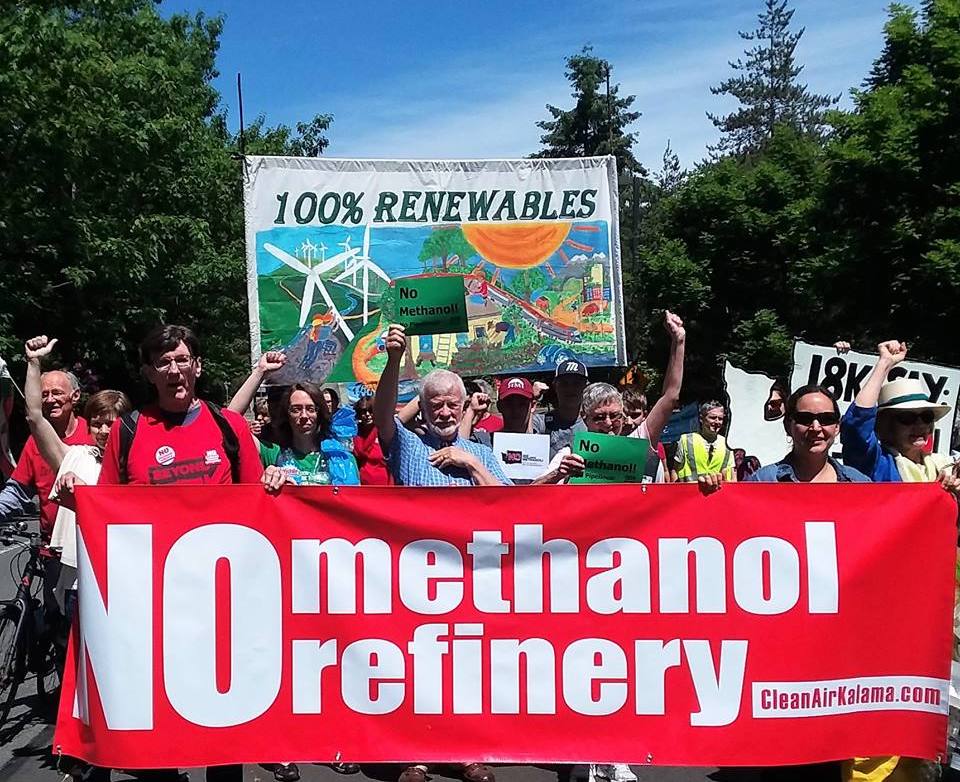 Protesters rally in Kalama, WA
Together we can protect our climate and the Columbia River. A critical public comment period is now open on the supplemental environmental review of the Kalama fracked gas-to-methanol refinery. Key decision makers need to hear your voice: the impacts of this project on our community and our environment are unacceptable.
The refinery would consume a stunning amount of fracked natural gas—one-third as much gas as used by the entire state of Washington. By 2025, the project could become Washington’s single largest source of climate pollution.
Tuesday, a report written by the company proposing the world's largest fracked-gas-to-methanol refinery was released by the Port of Kalama and Cowlitz County, Washington. The proposed fossil fuel refinery is controversial because of the impacts on both local residents' health and our climate. Despite the company's claim that the refinery could result in a climate benefit, the refinery would consume a stunning amount of fracked natural gas—one-third as much gas as the entire state of Washington.
"There is no way to make the world's largest methanol refinery look pretty. The project is dangerous, harmful to our health, and locks in decades of fossil fuel use," said Brett VandenHeuvel, executive director of Columbia Riverkeeper.
Please, include your own personal comment to be counted in EcoWatch's action:
A 2016 study by the Stockholm Environment Institute concluded that Northwest Innovation Works' proposal could increase overall global greenhouse gas emissions and is likely inconsistent with a low-carbon future. Last year, Northwest Innovation Works lost a lawsuit that required the company to evaluate the lifecycle greenhouse gas impacts of the methanol refinery. The report, released Tuesday as part the project's environmental review by local governments and Washington State, underestimates the refinery's greenhouse gas impacts: the report relies on cherry-picked studies, outdated information and highly speculative assumptions to frame the project as a win-win for climate and business.
"Governor Inslee understands the dangers of fracking and fossil fuels," said Cecile Gernez, conservation organizer with the Sierra Club Washington State Chapter. "Now is the critical moment for our governor to call out this fracked gas refinery for what it is: a dirty fossil fuel project."
Columbia Riverkeeper, Sierra Club and the Center for Biological Diversity faulted Northwest Innovation Works' report because it:
- Underestimates both the the amount and the potency of methane, a powerful greenhouse gas, that would be associated with the Kalama facility due to increased fracking. The company ignores or downplays multiple comprehensive studies finding a significantly higher methane-leakage rate than the report relies on and, in turn, underestimates the climate impacts of extracting and transporting the gas that will be processed at the facility. The report also relies on outdated metrics that underestimate the climate-disrupting impact of methane.
- Fails to properly evaluate the climate impacts of fracking if the company relies on fracked gas from the U.S. rather than Canada in the future. The report primarily assumes that Northwest Innovation Works will purchase gas from British Columbia for the lifetime of the project, ignoring shifting gas markets and plans for more gas pipelines from the Intermountain West to serve Pacific Northwest markets. Furthermore, the report underestimates the amount and greenhouse gas potency of U.S. gas.
- Relies on highly speculative assumptions about global methanol markets and China's use of coal-based methanol production. The report relies on a series of questionable assumptions about global methanol markets, energy commodity prices, Chinese government policy, and U.S.-China trade relations to conclude the project results in a net climate benefit.
- Does not properly account for the greenhouse gas impacts of methanol as a fuel source, a probable use of the methanol produced in Kalama. An April 2017 China Daily article quotes We Lebin, the chairman of the Kalama project's parent company, saying that the plant's output could "replace diesel, coal and gas with methanol to power vehicles." Lebin doubled down on the claims in a December 2017 Reuters article, saying that, "[the company] also wants to drive use of methanol as a transportation fuel for cars and ships." Yet the report does not analyze the greenhouse gas impacts of using the facility's methanol as fuel in comparison to non-fossil alternatives such as electric vehicles.
"The report spills a lot of words trying to justify polluting our air, risking our health, and taking private property to make petrochemicals to send to China. We're hopeful that Washington leaders choose a brighter future over this dirty plan," said Marrene Jenkins, a retired nurse and Kalama resident.
"This massive refinery would be a disaster for the climate, public health, and wildlife that rely on clean air and water," said Noah Greenwald, endangered species director for the Center for Biological Diversity. "The last thing we need is another fossil fuel project spewing pollution into our environment."
In addition to climate and health impacts, the methanol refinery would require a new pipeline to carry fracked gas. Landowners on the pipeline route have already received notice that the company can use eminent domain to take their land.
The Port of Kalama and Cowlitz County will hold a public hearing on Dec. 13. The Port of Kalama, Cowlitz County and the Washington Department of Ecology have authority to deny the project.
The good news: You can protect our climate and the Columbia. A critical public comment period is open now on the supplemental environmental review of the Kalama fracked gas-to-methanol refinery.
Protect the Pacific Northwest from new mega-fracked gas infrastructure by submitting a comment today!


