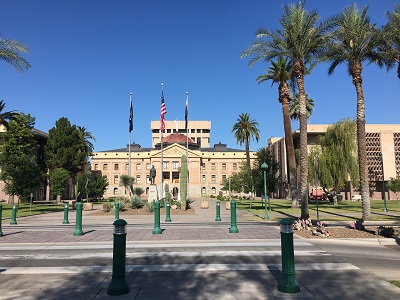
 Here we go. The Arizona legislature is off and running proposing a lot of really bad bills that make it more difficult to protect the environment, conserve water, or even vote. Please, weigh in on these bills on the Request to Speak app. You can weigh in on these bills anytime while they are still in committee. Since there are so many bills you might want to do the ones earlier in the week first and then do the ones that are being heard later in the week. For example, go ahead and weigh in on SB1068 before it is heard on Monday at 2pm and the bills being heard Tuesday. Or prioritize the ones that are most important to you. (For me that would be water bills. See my NOTE below.) If you haven't signed up for the system, you can find the form here: Directions on how to navigate the system: NOTE: From her comments at previous committee meetings, it is clear that Griffin is trying to tie the hands of the ADWR who are just trying to do their job (for example monitoring how much groundwater there is in certain areas.) Developers need to demonstrate a 100 year water supply. Being a realtor, Griffin is always trying to lower that standard. As you may be aware, Arizona's water laws are really lax. Rural areas are suffering from over-pumping for new development and industrial farms - leaving no water for small family farms and even causing sinkholes in the Wilcox area. New Active Management Areas (AMAs) were enacted to protect Wilcox and Douglas. Griffin has several bills that weaken or even end the AMAs. The Sierra Club also discourages augmentation (bringing water from other locations) because of the environmental impact and the creation of sacrifice zones (hurting the people who live on that land.) I personally agree with them and prefer conservation efforts. If you would like to learn more about AMAs you can watch this Sierra Club presentation:
|
Sunday, January 26, 2025
Push back on bad bills for our environment, water & voting rights

Sunday, January 19, 2025
Legislative Report & Request to Speak Actions on bad voting bills
 |
| (Condensed version of the Sierra Club's Legislative Update) |
This week, the 57th Legislature, First Regular Session, kicked off with the Governor's State of the State address -- well and a short prebuttal by Senate President Warren Petersen, who basically said whatever the Governor is for, he is against. Governor Hobbs focused on education, reproductive rights, housing, and water. On water, she talked about the need for limits in rural Arizona and also for developers to be accountable. You can listen to her full speech here or read it here.
Already legislators have introduced hundreds of bills, many of them concerning, including more harmful water legislation, measures to hinder voting, especially early voting, and bills to weaken environmental protection. We have started the bill tracker, but have not filled it out completely yet. You can see the tracker here.
Not unexpectedly, the Senate Judiciary and Elections Committee passed SB1011 early voting; ballot deadlines; certificates (Petersen: Angius, Bolick, et al.) along party lines. It removes authorization for counties to establish emergency voting centers, changes the deadline for dropping off early ballots to the Friday before the election, requires ID for early voting rather than merely allowing people to drop off their early ballot in the signed envelope as we do now. This would result in longer lines and more confusion and generally make early voting more difficult.
The Governor's budget was released today and included several line items related to water, air, waste, and parks. She is asking for $3 million to fund litigation on the Colorado River allocations as Arizona continues to fight with other states over an over allocated river that is stretched beyond its limits. She asks for additional funding for the Arizona Department of Water Resources to fund six additional full-time employees. There is funding for working on state implementation plans to meet Clean Air Act requirements and some funding related to the Iron King Mine, a federal Superfund Site. Of note, this year, the Governor included some funding for the State Parks Heritage Fund -- $2.5 million. While that is far from the $10 million it should be getting, it is better than the big zero it got last year. This is just her proposal and the Legislature is unlikely to embrace it.
REQUEST TO SPEAK ACTIONS
Don't forget to start registering support or opposition to bills with the Request to Speak system. Note that you do not have to speak if you use the system, you can just sign on the RTS app with a position on bills. If you have not created an account on the Request to Speak System, I encourage you to do so.
Sign onto Request to Speak Here:
https://apps.azleg.gov/account/signon
If you haven't signed up for the system, you can find the form here:
https://docs.google.com/forms/d/e/1FAIpQLScdjBMoAJrjHD57GGegmdUCKAowcr93K4vQA6a7_AjyElBtrQ/viewform
https://desktopactivisttucson.blogspot.com/2018/03/request-to-speak-time.html
Join the Sierra Club for a compelling and timely webinar presented by Rev. Katie Sexton, Executive Director of Arizona Faith Network, addressing the urgent issue of extreme heat in Arizona and its wide-ranging impacts on vulnerable communities, public health, and regional economies. Arizona faces record-breaking heat year after year, with Phoenix and Tucson ranking among the fastest-warming cities in the nation. Extreme heat amplifies ongoing challenges such as water scarcity, air pollution, environmental racism, and rising healthcare costs, further deepening inequities across our state. Tragically, we have seen hundreds of people die each year throughout the state due to this climate emergency, underscoring the urgent need for immediate action. In this session, Rev. Sexton will explore the need for legislative advocacy for heat relief funding, along with rapid response efforts and ongoing support to help mitigate the climate emergency and protect Arizona's most vulnerable populations.
12:00 PM
RSVP for the Zoom link
Tuesday, January 21st
House Natural Resources, Energy, and Water Committee at 2:00 PM
Members of the public may access a livestream of the meeting here.
Presentations:
Extreme Heat in Arizona and Heat Relief Funding at Noon!
House Natural Resources, Energy, and Water Committee at 2:00 PM
Members of the public may access a livestream of the meeting here.
Presentations:
- Overview of the Water Infrastructure Finance Authority (WIFA)
- Overview of Active Management Areas (AMAs) & Irrigation Non-Expansion Areas (INAs)
- Overview of the Department of Environmental Quality (ADEQ)
- HCM2003 stormwater; groundwater; recharge; urging support (Griffin) asks that the Arizona Department of Water Resources and State Land Department develop specific recharge projects on state trust lands. 331 sites have been identified by ADWR as having high potential for groundwater recharge. SUPPORT *
- HCR2016 reinstatement; WIFA monies (Griffin) is a resolution asking for reinstatement of the Water Infrastructure Finance Authority (WIFA) dollars. As most of these dollars are focused on funding out-of-state augmentation projects, we cannot support this. OPPOSE
Senate Government Committee at 9:00 AM
- HB2099 governor; attorney general; duties; immigration (Martinez: Biasiucci, Carbone, et al.) requires the governor and attorney general to cooperate with the federal government on immigration issues, read deportations. OPPOSE
House Federalism, Military Affairs, & Elections Committee at 2:00 PM
Members of the public may access a livestream of the meeting here.- HB2006 election mailings; third-party disclosures (Gillette) requires organizations that distribute official election-related documents, or documents that resemble official election-related documents, to include the words Not from a Government Agency in boldfaced on the outside of the envelope. This is an attempt to make outreach more difficult for those encouraging voting. OPPOSE
- HB2017 voting centers ban; precinct size (Keshel) prohibits the Board of Supervisors from authorizing the use of voting centers, removes language allowing a County Recorder to establish on-site early voting locations and limits the size of election precincts to a maximum of 1,000 registered voters. All of these will hinder not help people voting early. OPPOSE
- HCR2002 voting centers; precinct voting (Keshel) is the same as the measure above, except that it would go to the ballot. OPPOSE
Extreme Heat in Arizona and Heat Relief Funding at Noon!
Join the Sierra Club for a compelling and timely webinar presented by Rev. Katie Sexton, Executive Director of Arizona Faith Network, addressing the urgent issue of extreme heat in Arizona and its wide-ranging impacts on vulnerable communities, public health, and regional economies. Arizona faces record-breaking heat year after year, with Phoenix and Tucson ranking among the fastest-warming cities in the nation. Extreme heat amplifies ongoing challenges such as water scarcity, air pollution, environmental racism, and rising healthcare costs, further deepening inequities across our state. Tragically, we have seen hundreds of people die each year throughout the state due to this climate emergency, underscoring the urgent need for immediate action. In this session, Rev. Sexton will explore the need for legislative advocacy for heat relief funding, along with rapid response efforts and ongoing support to help mitigate the climate emergency and protect Arizona's most vulnerable populations.
12:00 PM
RSVP for the Zoom link
*This is Sustainable Tucson's take on this particular bill
Wednesday, January 15, 2025
Weigh in on Plan Tucson by January 31, 2025

Here is your opportunity to have a say on the future of Tucson by weighing in on Plan Tucson.
City boards and commissions apply to the plan when implementing Mayor & Council guidance and making recommendations. City staff refer to the plan for direction on their roles. And citizens can also refer to it when making recommendations.
The preliminary draft of the Plan Tucson 2025 General Plan Update was released last month and the city is looking for feedback. The deadline is January 31st at 5 p.m.
https://www.plantucson.org/
The preliminary draft of the Plan Tucson 2025 General Plan Update was released last month and the city is looking for feedback. The deadline is January 31st at 5 p.m.
https://www.plantucson.org/
Explore the preliminary draft at your own pace and provide feedback through the online Plan Tucson 2025 Preliminary Draft Surveys. Surveys for individuals cover:
- Overview and Implementation [Chapters 1, 2, and 5]: These chapters cover the plan overview, history of Tucson, characterization of Tucson today, and plan implementation.
- Values, Goals, and Policies [Chapter 3]: This chapter covers the draft plan's fourteen goals and associated policies. Provide feedback on as many goals as you like.
- Future Growth Scenario Map [Chapter 4]: This Chapter focuses on the draft map depicting future growth patterns and development guidelines for the City.
While the Plan Tucson document is admittedly very long, you can scroll down to the sections that are important to you. I recommend checking out Chapter 3, Values Goals and Policies.

Your input is vital to shaping Tucson's future. Visit the Plan Tucson website to review materials and participate in the planning process.
For questions, contact plantucson@tucsonaz.gov.
Saturday, January 4, 2025
Time for Action! Speak to Your Legislators at Environmental Day at the Capitol

Join us for the annual lobby day, Environmental Day at the Capitol, to advocate for environmental issues in our state. This is an opportunity to meet with your legislators, hear from great speakers, and connect with others who are doing advocacy work both inside and outside the Arizona Legislature. No experience necessary. The Sierra Club will be providing online trainings and workshops leading up to this day. They also provide one-sheets on bills they support that protect the environment. Join a small group of fellow citizens from your district to speak to your legislators or just enjoy the presentations!
Time to Act! Extreme Heat & Climate Justice
Environmental Day at the Arizona Capitol
February 12th, 2025
Arizona Capitol - Wesley Bolin Plaza
1700 W. Washington St.
Phoenix, AZ 85007
Please mark your calendar and RSVP. It is important to register so we know what legislative district you are in and also can plan for food and materials. Also, sign up for the free bus that is provided from Tucson.

Tuesday, August 27, 2024
Vote NO on all the props but one on November 5th


Civic Engagement Beyond Voting 2024 Propositions Guide:
Wednesday, August 21, 2024
Speak Up Against APS Gas Plant Expansion

Arizona Public Service (APS) is seeking a Certificate of Environmental Compatibility (CEC) to add approximately 397 megawatts (MW) of new gas to its existing 1,060-MW Redhawk gas-fired power plant in the western portion of Maricopa County. This proposed expansion will consist of 8 additional gas-fired turbines.
Why is this concerning?
The Redhawk power plant expansion project would increase air pollution in a part of Maricopa County that already has poor air quality. There is a residential neighborhood located less than two miles from the Redhawk plant, and Arlington Elementary School and its community sports fields are located less than 2.5 miles from the plant. Air pollution from the project will harm the health of nearby residents, including children. Exposure to air pollutants produced by gas-fired power plants causes increases in lung diseases, heart diseases, and premature deaths. Residents who live near power plants are generally exposed to more air pollution and therefore experience worse health impacts on average. Learn more and find talking points here.
Sign the petition here.
Monday, August 5, 2024
2024 Environmental Report Card for AZ Legislature & Governor
Session Characterized by Inaction on Key Priorities – Water, Climate, and Environmental Justice
.jpg)
Phoenix, AZ – Today, Sierra Club, joined by Chispa Arizona and Arizona Asian American, Native Hawaiian, and Pacific Islander (AANHPI) for Equity, released the 2024 Environmental Report Card for the Arizona Legislature and Governor.
“The 2024 legislative session was disappointing as legislators again missed opportunities to act on climate, environmental justice, and water, and unfortunately passed water legislation that does more harm than good, failing to address groundwater issues for rural Arizona or protect any rivers or streams,” said Sandy Bahr, director for Sierra Club’s Grand Canyon Chapter. “As if that were not bad enough, legislators loaded up the ballot with referrals, including one to make it difficult to advance rules to protect our air and water, one to target immigrants, and one to hinder citizen initiatives.”
While nearly everyone seemed to agree that Arizona needed to take action on water, especially as wells in rural Arizona continued to be pumped dry by industrial agriculture and an assured water supply was no longer available in parts of the Active Management Areas. It turns out, however, that developers, big agriculture, land and water speculators, and private water companies were all interested in continuing business as usual with unsustainable sprawl development and pushing through bills that changed the rules to accommodate that. The rural water issues were left unaddressed as there was no agreement on doing something meaningful.
“How will our younger and future generations see us? To know that we continuously chose profit over one another, over our home, our water, and over the healthy future of our children and loved ones,” said Nile Bunger, climate justice director with Arizona AANHPI for Equity. “The one place they rely on to keep them safe. What will the children say? How will we respond? Will we feel confident in our responses? If we can’t fight to save our planet outside of earth day, how can we expect our children to? One of the biggest acts of love we can give to one another is protecting our water rights and environment for all; although, time and time ago we ignore the concerns that are negatively affecting our BIPOC, rural, and marginalized communities. Our youth and younger generations are learning how to be humans based on how we act as a human. The policies we create and support, the elected officials we vote into office, and if we hold them accountable or not when our voices and needs are being harmed over profit. A healthy environment and access to clean water should not be a privilege, yet it is. It is vital that we do not exclude the voices of the community and the future of Arizona’s water rights. Our rural areas and communities deserve better. And may we remember that we are all part of nature, so we must act as such.”
“The Arizona legislature holds great power and ability to make laws that impact us in our daily lives,” said Alondra Morales, climate justice program coordinator forAZ AANHPI for Equity. “This report card serves as a clear summary of which legislators have the community in mind and which legislators have other priorities. I hope this is helpful guidance to the people of Arizona to get to know their legislators!”
“It’s very clear that lawmakers who hold the majority at the legislature do not look out for the interests of the people of Arizona. Every step of the way during this legislative session we saw them ignore the will of the people and act in ways that benefit private interests,” said Vania Guevara, political and advocacy director for Chispa Arizona. “We will continue to work diligently to connect our people to their own power by showing up in this space because we belong there. We will keep partnering with legislators that are environmental justice champions to push this body to protect the air we breathe, our access to public lands, and our right to an easy and accessible democracy.”
One senator and 14 representatives earned an “A+” on the 2024 Environmental Report Card – they voted pro-environment and did not miss any votes. Unfortunately, all of the Republican caucus earned an “F” this year as they pushed a plethora of bad water legislation at a time when we desperately need strong protections for groundwater, as well as for our rivers and streams. They also voted for a large number of referrals that, if passed, would seriously harm efforts to advance clean energy, protect our air and water, and our democracy.
The 2024 Environmental Report Card is available on the website in English here and Spanish here.
The Sierra Club is one of the largest and most influential grassroots environmental organizations in the U.S., with more than 3.5 million members and supporters. In addition to protecting every person’s right to get outdoors and access the healing power of nature, the Sierra Club works to promote clean energy, safeguard the health of our communities, protect wildlife, and preserve our remaining wild places through grassroots activism, public education, lobbying, and legal action. The Grand Canyon Chapter of the Sierra Club, representing 16,000 members, has a long history of advocacy at the Arizona Legislature.
Chispa Arizona builds the capacity of Latinx families to influence policy makers and pressure polluters to protect communities’ rights to clean air and water, healthy neighborhoods and a safe climate for generations to come.
Arizona Asian American Native Hawaiian and Pacific Islander (AANHPI) for Equity is a state-wide organization striving for equity and justice by building power through community directed organizing, increasing civic engagement, and empowering young leaders.
Subscribe to:
Posts (Atom)